By Shehroze Ahmed Shaikh, MA, and Emily Burton, PhD, Oral Historian
Introduction
According to the Statistics Canada 2021 Census of Population, there are now several municipalities in the Greater Toronto Area, including Toronto, Brampton, Mississauga, and Markham, where immigrants make up over 40% of the population.[1] This article focuses on the experiences and reflections of people from Pakistan, India, and Syria who have come to Canada as refugees, migrants, or immigrants, and have experience as Uber drivers in the Greater Toronto Area. We explore their experiences and reflections through oral history interviews recorded in the fall of 2024. In addition to five interviews with people with experience, past or present, driving Uber, we also draw upon two additional interviews with three people—one with the spouse of an Uber driver, and one with two people, Anam Zakaria and Haroon Khalid, who instigated Driving Canada: A Collaborative Oral History Project.[2]
Founders of Qissa, an organization that focuses on oral histories of immigrants to Canada, Anam and Haroon worked with Emily Burton, Oral Historian at The Canadian Museum of Immigration at Pier 21 (CMIP) to record the interviews. For more on this collaborative project, including photographs from the interviews, an overview of the interview participants, and reflections from Anam, Haroon, and Emily on the process, please see: Driving Canada: A Collaborative Oral History Project. Shehroze Shaikh, CMIP Research Intern, subsequently worked with Emily on analyzing and interpreting the interviews, as a distinct Museum project. This article shares key insights from this research process relating to the following themes: work experiences and expectations before coming to Canada, job market challenges and driving Uber, and the future aspirations and goals of the participants. We explore the main theme relating to Uber driving through the sub-themes of immediate income generation, working conditions, and cultural exchange and skills development.
Taken together, the interviews offer unique first-person testimonies that do not speak for all Uber drivers. Nonetheless, the interviews do suggest that the contemporary landscape of immigrant Uber drivers in the Greater Toronto Area represents both continuity and rupture with Canada's longer patterns of racialized migration and labor. Understanding South Asian and Syrian migration histories reveals how current Uber drivers navigate systems that echo historical exclusions while creating new forms of economic participation.
Before turning our attention to the oral history interviews, we offer some historical background regarding longer patterns of work and migration in Canada, with specific reference to people from South Asia and Syria. Following this, we outline the process of analyzing the seven interviews, and share our findings related to the themes of work before immigration, job-market challenges and driving Uber, and future aspirations and goals of participants.
Historical Context
South Asian Migration: Patterns of Agency and Resilience
South Asian immigration to Canada demonstrates remarkable continuity across more than a century. Beginning with the 1897 arrival of Sikhs as part of Hong Kong military contingents en route to Queen Victoria's Diamond Jubilee, early migrants established patterns of agency that persist today.[3] As immigration scholar Manum Shahid's analysis demonstrates, South Asian immigrants were never "passive actors" but actively maneuvered immigration systems to their advantage, challenging narratives that credit state policies alone for migration outcomes.[4]
The early twentieth century saw over 5,000 South Asians, predominantly Punjabi Sikhs, settle in British Columbia before 1908, primarily working in lumber mills and on railroad construction.[5] However, the implementation of exclusionary policies—including the 1908 Continuous Journey Regulation and elevated financial requirements—forced migrants to develop creative strategies for entry and settlement.[6] Shahid documents how communities mobilized through gurdwaras, raised legal defense funds, and used both legal channels and extralegal methods to maintain their presence in Canada.[7]
The 1930s saw a decline in the logging industry due to the effects of the Great Depression. Overall immigration decreased during this decade, as well as the following decade due to the Second World War. Exclusionary immigration policies favouring Europeans continued after the end of the war, although the Canadian government also initiated a policy change in 1951 that contributed to an increase in South Asian immigration to British Columbia. The shift involved the signing of immigration agreements with India, Pakistan, and Ceylon (Sri Lanka) permitting 150, 100, and 50 citizens from each country, respectively, per year.[8]
Unions representing resource-based labourers also expanded during this time, and began to move away from the exclusion of workers based on race and ethnicity that had characterized the earlier twentieth century. Interdisciplinary scholar Kamala Elizabeth Nayar notes that, after the Second World War, "unions had come to the realization that they needed ethnic support in order to build their bargaining power."[9] Starting in the 1970s, many Sikhs, including second-generation children of immigrants, migrated to urban centres in British Columbia and elsewhere, following a gradual decline in forestry and other resource-based industries. In recent decades, many South Asian immigrants have moved directly to urban areas, and have higher levels of educational attainment than early-twentieth-century migrants.[10]
This historical pattern of community mobilization and economic adaptation provides an interesting context for understanding contemporary South Asian Uber drivers. The shift from lumber mills to transportation services represents both continuity in working-class employment and adaptation to urban service economies. Like their predecessors who navigated racist exclusions in industrial work, today's drivers face regulatory challenges and economic precarity, while also building community networks of mutual support.
Syrian Immigration: Historical Foundations and Contemporary Displacement
Syrian and broader Arab immigration to Canada follows a more complex temporal pattern, with significant early twentieth-century settlement followed by recent refugee arrivals. By 1911, approximately 7,000 "Syrians" (a category encompassing Lebanese and other populations from Greater Syria) had settled across Canada, with notable concentrations in industrial regions like Cape Breton, Nova Scotia, and Prairie communities.[11]
Early Syrian immigrants typically entered through peddling—what historian Sarah Carter describes as an "independent but relatively low-status occupation."[12] This economic positioning mirrors contemporary Uber driving, as both represent forms of entrepreneurial labor that provide autonomy while remaining marginalized within broader economic hierarchies. The more-recent arrival of Syrians as refugees, however, also represents a divergent migration dynamic, wherein many people are highly educated and qualified, and face distinct challenges related to credential recognition and economic integration.[13] However, the presence of established Arab Canadian communities provides some infrastructural support. For instance, Rammah Mohammad, one of the Driving Canada participants, spoke about how his music has found an audience among the established Arab diasporas of Canada.[14]
Understanding the Interviews
The interviews generally followed a chronological pattern. Participants began talking about their early lives and upbringing in their hometowns, before outlining their education, early adult life, and eventual migration to Canada. We analyzed the Driving Canada interview content relating to these migration journeys using qualitative software (MAXQDA) to assign descriptions, or codes, to interview segments. We then examined the aggregated data to help us explore the issues the interviewees spoke about the most, which in turn allowed us to develop themes and sub-themes from the interviews.
The main codes we created were the following: Origins, Family, Childhood, Community, Education, Work, Immigration Experience, Uber, COVID-19, and Reflections. Each main code then had between three and eight sub-codes. For example, “Work” included sub-codes for Pre-immigration, Post-immigration, Job Market Challenges, and Other. The coding yielded over 650 individual segments, in which Work-Pre-immigration and Family occurred the most.
We then created code clouds and transcript-based word clouds from the interviews to get a visual representation of our analysis. Here is an example of each, based on Kulbir Singh Bhullar’s interview, with the first one being the code cloud and the second one being the interview cloud.[15]
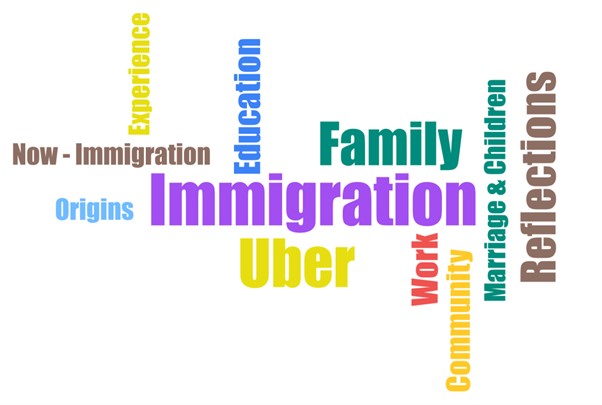
Credit: Shehroze A. Shaikh.
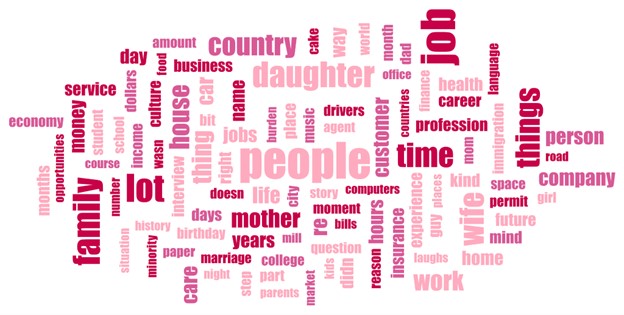
Credit: Shehroze A. Shaikh.
Research Themes
As the primary focus of the project as a whole was on Uber driving, the main theme we explored was job market challenges and driving Uber in Canada. We explored this theme through sub-themes associated with driving Uber: immediate income generation, working conditions, and cultural exchange and skills development. Prior to exploring these, we outline peoples’ work experiences and expectations before coming to Canada. We conclude with a brief look at how interview participants saw their future aspirations and goals at the time of the interview.
Pre-Migration Work Experiences and Expectations for Work in Canada
I had no rosy expectation…I knew it was going to be racist. My experience was all over the place. My experience in teaching will not really count in Canada…I will not be able to get into journalism because my journalism is also very beat related…I’m like I don’t want to work at McDonalds or…do Uber. And that was the best-case scenario...the idea of moving just like that itself is frightening, but like even that idea of moving and having to start again and just like how do you even translate your experience, the Pakistani experience, to Canada?[16]
Haroon’s reflection on the questions he had before immigration—questions that led him and Anam to pursue the Driving Canada project—represents a key takeaway from the interviews. For the participants, both their pre-immigration work and their anxieties over the reality of immigrant life not matching up to it were important aspects of their stories. Work was the most-frequently assigned code overall, with 115 instances—over 17% of all coded segments. In the context of economic aspirations that were central to the journey of so many immigrants, this was not so surprising. However, it is interesting to note that almost 42% of the Work codes were Work-Pre-Immigration, highlighting the importance people placed on their work experiences before coming to Canada, as all interview participants had arrived in Canada fairly recently (between 2018 and 2024).
Seven of the eight interview participants described having well-established careers in their home countries before deciding to move to Canada—a decision that was made for a variety of reasons, such as looking for a better future for their children, further education and career growth, or to protect themselves in the face of political repression. Yalgar Singh, for example, described having a decent IT job in the government sector in India, but decided to move to Canada to further his goal of building his family a home: "Canada seemed to be a very lucrative approach…to get married, you need to have a home, you need to have a car…I had nothing."[17]
Yalgar eventually married Niharika Agarwal, also an interview participant for the Driving Canada Project. Yalgar and Niharika had been university classmates in India, and reconnected after arriving in Canada through mutual friends in the Greater Toronto Area. Niharika described the initial days of their relationship in Canada, where finding time to date was difficult due to Yalgar’s Uber driving schedule. They would often spend time together at one of their homes, choosing to stay in rather than go out and spend money.[18] Reflecting on job market challenges of her own, she recalled her pre-immigration work experience, and the conundrum that “international experience” puts on immigrant workers in terms of not having enough “Canadian experience” to land roles commensurate with their skills, while also being overqualified for entry level roles:
So when I came here, I thought that I’ll be going through the part-time jobs…since I have a great experience back home, I will be offered a job very easily…But when I came here, I realized that nobody even cares that I’m here, let alone a part-time job…I wish they [employers] would be more cooperative. I mean, every, every employer wants someone with Canadian experience. I do get it that you want that kind of ethics and the culture at your work, but if you don’t allow anybody with a chance, how will they gain one?[19]
Participants saw their pre-immigration positions and professions disrupted after moving to Canada. Pushed away from their career aspirations, people nonetheless importantly saw their pre-immigration experiences as reminders of their identities, with some people also reflecting on the growth that they might have had if they had decided not to immigrate. These challenges were key in driving them towards alternative career paths and employment prospects outside of their skillset and experience—and eventually deciding to become Uber drivers.
Job Market Challenges and Driving Uber in Canada
Anam recalled an Uber ride with Haroon on the way back from their eighth doctor’s visit where they had failed to secure an appointment for their daughter’s ear surgery. The exchange during the ride prompted her and Haroon to initiate the Driving Canada project:
We sit in the car and, you know, the person who was driving us, we had started having a conversation. It turned out he was a refugee from Afghanistan. And I said, “Well, what did you do in Afghanistan before you moved?” And it was pin-drop silence and I thought I asked something really offensive. I don’t know what happened. He started crying and he said, “I was an ENT.” And just that moment of like us wanting to find a doctor for Lena, you know, sitting here trying to find an ENT and here we are in an Uber, you know, disgruntled from our visit with the doctor and here’s a person who’s an ENT and he said, you know, I moved to keep my kids safe. And I’m trying to study now to see if I can get an equivalency, but look at my age. He was, you know, fifties or sixties.[20]
This incident reveals the systemic ways in which the Canadian job market marginalizes immigrants embodying complex histories of economic, social, and political precarity. Immigration to Canada may be an escape from these precarities, but the Driving Canada interviews shed light on how, for many immigrants, structural obstacles such as a lack of recognition of their foreign education, credentials, and experience means they are often swapping one set of precarities for another. The tension between professional qualifications and current employment created ongoing challenges for participants' sense of identity, and the interviews reveal how participants navigated questions about their career transitions.[21] In this regard, this small study shares unique experiences and contributes insights into this very large question.
Participants also faced the challenge of explaining their situation to family back home. Some of the Uber drivers Anam and Haroon contacted indicated they did not want to participate in the Driving Canada project after learning that the interviews would be video-recorded, because their families did not know they were Uber drivers. Anam and Haroon noted in their interview that some people were very direct in explaining this to them: "And for a lot of people, they're selling everything. Sometimes they're borrowing money...This has to work for them, right. But to tell their families that after all that investment, ‘I'm struggling here, I don't know if I'm going to survive.’"[22]
The necessity of driving Uber to make ends meet temporarily cast immigrants beyond the realm of formal, secure employment. It offered very little financial growth and health benefits in return for grueling work hours. However, the transition to Uber driving also represented more than just a temporary employment solution where few other options were available—it became a complex negotiation between economic survival, professional identity, and family obligations.
Uber-related codes represented almost 10% of all coded segments, with 63 codes in total. Given the focus of the project on Uber driving, this was not surprising. However, the interviews were fluid in order to allow participants to take the conversation where they wanted in terms of their overall immigration stories, revealing how central the Uber experience became to their Canadian journeys.
A closer examination of the Uber sub-codes reveals the multifaceted nature of this work experience. Uber-Experience was the most frequently occurring sub-code, with 25 instances followed by Uber-Other with 12 instances, and Uber-Driving Hours & Earnings with 10 instances. A key research finding revealed through this distribution is that participants spent considerable time reflecting not just on the practical aspects of earnings and schedules, but also on the broader experiential dimensions of this work—the people they met, the skills they developed, and the ways it shaped their understanding of Canadian society.
The following section explores the research findings relating to Job Market Challenges and Driving Uber in Canada in more detail through several sub-themes that outline both opportunities and challenges. We see how driving Uber served multiple functions, providing opportunities for immediate income generation, flexible work arrangements that accommodated job searching, and spaces for cultural connection and learning about Canadian society. The participants were also forthcoming about the economic and social challenges, including the hidden costs of vehicle maintenance, and deteriorating working conditions.
Immediate Income Generation
For many participants, Uber represented an avenue for immediate income generation with lower barriers to entry than the formal employment sector. All five participants with a history of driving Uber recounted experiences of repeated failure in securing formal employment within their fields of experience or study, and eventually deciding to drive Uber to have some kind of income for living expenses. Yalgar recalled how he lowered his expectations for employment after every rejected job application—a step-by-step process that pushed him further and further from his primary professional skillset:
Beggars cannot be choosers, so once bank accounts are draining out, you try to look for other jobs. You cannot just be there searching for the jobs you like. You have to be open to anything. Firstly, I came down to analyst roles. Then I came to clerical roles. Then I actually started looking for Tim Hortons, McDonalds. Then somebody advised me, “Oh, you can do Uber.” Then I got into that because, you know, you’re not having money to pay your day-to-day expenses. I think even breathing in Canada is costly day to day, so you have to make things work. So one thing lead into another. I started as Skip driver, Skip the Dishes, then did Uber Eats, then after a while finally got some PTC [Private Transportation Company] license in Uber for Toronto and everything. Then I started Uber.[23]
Kulbir did find employment in a customer service role, but the company eventually laid him off. He had to start driving Uber to provide for his family. At the time, his employer told him: “..maybe you’re a very good guy. We can expand in future, we can call you for a customer service job again. But right now, for this job…we’re terminating the contract.” Kulbir describes how he was “heartbroken” with the news. He called them a month later, but the company had closed the office.[24] He then pivoted to driving Uber:
I had a family to take care of. My wife wasn’t eligible to work full-time. So I decided to drive. That is the moment I decided to do Uber. And sometimes I feel and I think if such gig jobs for not in picture, look how many homeless people we would have created in Canada. But yeah, that was one thing that came to my rescue.[25]
Working Conditions
Being an Uber driver often involved very long working days. Yalgar, for instance, talked about working 12-14 hour days. He also noted that some of that time was without passengers, and that market saturation affected his earnings. He attributed this in part to a downturn in the economy: “…the recession came...Everybody went into Uber, so there was huge waiting lines, so it was not that good as it used to be.”[26]
The long hours associated with driving Uber could be a hidden social cost in terms of the impact on family life for parents. Kulbir's description of missing time with his daughter while working long hours illustrates this challenge:
Even with Uber, even with those gig jobs, I ended up going 17 to 18 to 19 hours a day of driving, so when I leave home, the better future for my daughter, the picture I see is sleeping. My daughter is sleeping, right. And then when I leave home, this what happens. And I drive all day, I come back home, she’s already sleeping again. I hardly get to talk to her, interact to her. And then, just to make sure the ends meet, I’m sacrificing that time I’m supposed to be with her.[27]
Mohammad Javed Khokar’s discussion of his earnings illustrates the gap between gross income and actual profit that made the long hours a necessity. Car payments, insurance, maintenance, and gas accounted for about 40 per cent of his monthly Uber earnings. He compares this to working 50-hours a week at a restaurant: "I'm only left with…200 or 300 more than what I was making while working in that restaurant."[28]
Participants consistently reported that Uber working conditions had worsened over time, with increased competition and algorithmic changes reducing earnings. Javed also associated the declining pay with a surplus of drivers on the road. In addition, he discussed the impact of platform changes with the introduction of Artificial Intelligence (AI):
I don't know how it works. But the AI decides what is going to be your compensation for this ride, which is absolutely unfair because I've experienced it and just not me. People in the same community who work with the same gig for a living, they've experienced it and nobody likes it because they, for every ride, they feel that they're being underpaid.[29]
Although being an Uber driver involved many constraints and challenges, including an irregular income and lack of employment benefits, interview participants also cited flexibility in the working conditions as a key benefit of Uber driving. Rammah explained how Uber accommodated his pursuit of music: “…if we're having show rehearsals and stuff, I don't need to ask the manager, ‘Hey, can I go for it?’”[30] For Javed, Uber provided the flexibility needed to continue job searching while maintaining an income:
I left my restaurant job in October last year, just two months after I received my PR [Permanent Residency] invitation. I left that job and then, from then, I was only doing Uber because while I was working in the restaurant, I wasn’t actively applying because I was physically and mentally so tired that I never had enough time in my day to apply or look for these kinds of opportunities. That’s when I decided to leave this job because when you’re doing Uber, you are flexible, right. You can make your own schedule.[31]
Cultural Exchange and Skills Development
In addition to flexibility, participants also found value in the cultural interactions associated with being an Uber driver. Javed noted that he enjoyed talking with new people in his car, and that it helped him improve his communication skills. It also helped him see the best in people: “I try to communicate with them...And eventually I realized that people are nice. They don't see you just as a taxi driver. They see you as a normal person the way, you know, just like any other person.”[32]
Mehakjot Singh also noted that he loved interacting with people and learning from them. He described how Uber exposed him to diverse communities: “I got a lot of people from different countries...I keep on interacting with them and learning the new things from the people who sit with me in my Uber.”[33]
Participants consistently highlighted how their Uber experience contributed to skill development, particularly in communication and cultural competency. Javed explicitly connected his improved communication skills, earned through interaction with Uber passengers, to his professional success:
I used to be like a very introvert kind of a person. I never spoke to anyone around me. And I still have that but it’s—it’s better now. I got a chance to improve my vocabulary. My grammar is better now. I can hold a conversation for a while with a random person. It also made me better professionally as well because, like I mentioned earlier, I’m a salesperson. I sell pharmaceutical drugs for a living. These kind of qualities are important for my profession as well, so I’m kind of able to, you know, trade this benefits from one profession to another. I think, I think this has helped me a lot, and I'm, I'm glad this, that this happened to me.[34]
The geographic knowledge gained through driving also represented a form of cultural capital. Mehakjot described memorizing the urban landscape of the Greater Toronto Area, and decreasing his reliance on GPS:
I memorize, you know, the very, very small roads, the downtown thing and the middle town thing, each and every road, each and every street I memorize by heart. Initially when I have to go to downtown, I have to put on a GPS on my phone and then every time, now I can drive without GPS to downtown and I can take my parents or anybody who, who want to drive with me to any of the streets they want to.[35]
Future Aspirations and Goals of the Participants
Interview participants tempered, but did not forget, future aspirations and goals due to income-generation pressures and family needs.
The need for an income that led people to drive Uber created tensions regarding long-term career aspirations, a tension that could involve complex negotiations for participants. Despite the challenges they faced, most people maintained hope for professional advancement while acknowledging the uncertain timelines for achieving their goals. They viewed Uber driving as a temporary necessity rather than a permanent career choice. Rammah expressed this sentiment: “Hopefully not for long. Once music pick up little bit more, I think I will do Uber less until it's maybe not needed, maybe, but for now, it's still there.”[36] Other interviews also revealed how extended periods working in the gig economy could reshape career trajectories. At the time of his interview for instance, Javed had successfully transitioned out of Uber driving, but he acknowledged the role it played in his journey.[37]
The interviews reveal participants' awareness of systemic barriers while maintaining individual agency in pursuing their goals. Javed’s successful transition to sales demonstrates that advancement is possible, although it required sustained effort over an extended time. As noted previously, his time as an Uber driver helped him develop communication skills that he was able to bring forward in his new position as a pharmaceutical sales person—a position closer to his education and career aspirations.
The participants' stories ultimately illustrate how individual determination intersects with structural constraints. While some successfully transitioned to career-appropriate employment, others remained in survival work due to ongoing barriers to professional recognition and integration.
Conclusion
The Driving Canada interviews reveal that Uber driving serves as more than temporary employment for skilled immigrants—it functions as a complex space of economic survival, cultural learning, and identity negotiation. Participants both valued the flexibility that gig work provided for job searching and family obligations, and contended with significant hidden costs, deteriorating working conditions, and the challenge of maintaining a professional identity while engaged in survival work.
The Driving Canada project offers a glimpse of contemporary experiences of migration and work precarity, while also pointing to areas for additional analysis in future projects. One of these is the persistence of transportation as a viable sector for immigrant labour, be it early railroad workers, or the Uber drivers of today.
The experiences documented in the Driving Canada project do highlight broader systemic issues in immigrant integration, including credential recognition, the Canadian experience paradox, and the gap between immigration promises and employment realities. Participants also demonstrated remarkable resilience and agency, using their Uber experience to develop communication skills, build cultural competency, and maintain hope for professional advancement. Whereas earlier migrants faced obstacles due to exclusionary practices written into legal structures, the Driving Canada participants bring our attention to practices that continue to exclude immigrants despite governmental provisions to the contrary.
These stories illuminate the human cost of structural barriers in immigrant employment while also revealing the innovative ways that newcomers navigate and resist these constraints. Understanding these experiences is crucial for developing more effective integration policies and support systems for skilled immigrants in Canada.
The authors thank Anam Zakaria, Kulbir Singh Bhullar, Steve Schwinghamer and Jan Raska for their feedback on earlier drafts.
- In Toronto, for instance, the 2021 census lists 1,286,149 people, out of a total population of 2,761,285 (or 46.6%), as immigrants. See Statistics Canada, 2021 Census of Population, Immigrant status and period of immigration by gender and age: Census subdivisions with a population of 5,000 or more, Table 98-10-0348-03. https://www150.statcan.gc.ca/t1/tbl1/en/tv.action?pid=9810034803. This information also draws from an internal report: Lyndsay Van Dyk, “Oral History Gap Analysis: Canadian Museum of Immigration at Pier 21,” 2024, 9-10. For the purposes of this study, we refer to the Greater Toronto Area, and not the Greater Toronto and Hamilton Area.↩
- First references for all people include full names, while subsequent references include first name only.↩
- Canadian Museum of Immigration at Pier 21 (hereafter CMIP), “1897, Arrival of first Sikhs,” A Timeline: Immigration and Impact, https://timeline.pier21.ca, and South Asian Studies Institute, “1897, South Asian migration to Canada commences,” History of South Asians in Canada: Timeline, https://www.southasiancanadianheritage.ca/history-of-south-asians-in-canada/.↩
- Manum Shahid, "Agency and Resilience: South Asian Migration to Canada, 1900-1967" (HIST 560: World History Seminar, Toronto Metropolitan University, 2022), 1. See also: Gunn Prize – Winning Essays – Canadian Immigration Historical Society.↩
- For more on Sikh and Punjabi migration to British Columbia, as well as a discussion Sikh and Punjabi historical and cultural identity, see Kamala Elizabeth Nayar, The Punjabis in British Columbia; Location, Labour, First Nations, and Multiculturalism, Montreal & Kingston: McGill-Queen’s University Press, 2012, 8-9.↩
- See CMIP, “Continuous Journey Regulation, 1908,” https://pier21.ca/research/immigration-history/continuous-journey-regulation-1908.↩
- Shahid, "Agency and Resilience," 6-7.↩
- The agreement followed the 1947 Partition of India and Pakistan. See CMIP, “Order-in-Council PC 1931-695, 1931,” https://pier21.ca/research/immigration-history/order-in-council-pc-1931-695-1931 and “1951, Immigration agreements with India, Pakistan, and Ceylon (Sri Lanka),” https://timeline.pier21.ca. See also: South Asian Studies Institute, “1951, Quota system for South Asian Immigration,” https://www.southasiancanadianheritage.ca/history-of-south-asians-in-canada/.↩
- Nayar, The Punjabis in British Columbia, 13.↩
- In 2006, 39% of the South Asian population in Canada had obtained a bachelor’s degree or higher, with this percentage increasing to 58% by 2021. The latter includes people born in Canada who identified as South Asian, representing almost 3 in 10 South Asians in Canada. Statistics Canada, “Portait of the South Asian Populations in Canada: Diversity and Socioeconomic Outcomes,” December 8, 2025. https://www150.statcan.gc.ca/n1/pub/89-657-x/89-657-x2025007-eng.htm.↩
- Sarah Carter, "Old Stock Canadians: Arab Settlers in Western Canada," Active History, https://activehistory.ca/2017/03/old-stock-canadians-arab-settlers-in-western-canada/.↩
- Carter, "Old Stock Canadians."↩
- Over 100,000 Syrians have arrived in Canada since 2010, with many settling in the Greater Toronto Area. See https://www.international.gc.ca/world-monde/issues_development-enjeux_developpement/response_conflict-reponse_conflits/crisis-crises/conflict_syria-syrie.aspx?lang=eng.↩
- Rammah Mohammad, interview by Anam Zakaria, October 25, 2024, in North York, Ontario. Canadian Museum of Immigration at Pier 21 (hereafter CMIP) in collaboration with Qissa (24.10.25RM).↩
- Code Cloud and transcript-based Word Cloud using MAXQDA, based on interview: Kulbir Singh Bhullar, interview by Anam Zakaria, October 27, 2024, in North York, Ontario. CMIP in collaboration with Qissa. (24.10.27KSB). Kulbir Singh Bhullar also goes by Kulbirsingh Bhullar.↩
- Anam Zakaria and Haroon Khalid, interview by Emily Burton, October 28, 2024, in North York, Ontario. CMIP in collaboration with Qissa. (24.10.28AZHK): [01:57:49].↩
- Yalgar Singh, interview by Haroon Khalid, October 26, 2024 in North York, Ontario. CMIP in collaboration with Qissa (24.10.26YS): [00:31:25].↩
- Niharika Agarwal, interview by Anam Zakaria, October 28, 2024 in North York, Ontario. CMIP in collaboration with Qissa. (24.10.28NA): [00:51:58].↩
- 24.10.28NA: [00:35:07].↩
- 24.10.28AZHK: [02:31:41].↩
- Anam and Haroon’s encounter with an ENT surgeon driving Uber also illustrates the prevalence of professional deskilling (24.10.28AZHK).↩
- 24.10.28AZHK: [02:38:43].↩
- 24.10.26YS: [01:08:45].↩
- 24.10.27KSB: [00:57:00].↩
- 24.10.27KSB: [00:57:00].↩
- 24.10.27KSB: [00:57:45].↩
- 24.10.26YS: [01:31:06].↩
- 24.10.27KSB: [00:59:00].↩
- 24.10.27MJK: [01:10:12].↩
- 24.10.27MJK: [01:10:30].↩
- 24.10.25RM: [00:48:50].↩
- Mohammad Javed Khokhar, interview by Haroon Khalid, October 26, 2024 in North York, Ontario. CMIP in collaboration with Qissa (24.10.26MJK): [01:04:09].↩
- 24.10.26MJK: [01:04:09].↩
- Mehakjot Singh, interview by Anam Zakaria, October 25, 2024, in North York, Ontario. CMIP in collaboration with Qissa (24.10.25MS):[01:19:45].↩
- 24.10.27MJK: [01:19:45].↩
- 24.10.25MS: [01:24:13] .↩
- 24.10.25RM: [01:21:27].↩
- 24.10.27MJK.↩