Sobey Wall of Honour
Column
42
Row
21
Pier 21 Story from Guenther Weber and Family
Guenther Carl Heinrich Weber and Margarethe Elisabeth Weber (widowed Hoppe) along with their daughter, Anngret Hiskea Hoppe, moved from East Germany to WG in 1946. They left WG for Canada because they were afraid of another war in Europe.
They received a visa for Canada which was valid for only three months since they had to prove they were clear of TB. They were only allowed to take $50 per person, so they bought a camera and binoculars to sell in Canada. It was a difficult decision to leave Germany since Guenther had a good job as an engineer and he thought his job prospects in Canada would be curbed by his limited English.
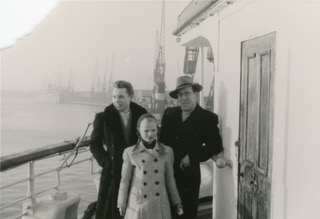
When they departed, Guenther was 36, Margarethe was 34 and Anngret was 9 years old. They had an inside cabin close to the engine, so it was noisy and hot. There were three beds in the cabin, but no water and the washrooms were on a different level of the ship. Guenther and Grete paid their own fare (lowest class fare) for the voyage. They left Hamburg on February 7, 1952, and arrived in Halifax on February 16, 1952. Grete was seasick the whole trip except for one day and therefore spent almost all her time in the cabin. Anngret was seasick occasionally, and Guenther was fortunate to not have been seasick at all. The food on the ship was good. Most passengers on the ship were from Germany, even though the ship stopped in England and France as well. The ship was Italian owned, weighed 10,000 tons, and was staffed by Germans. Guenther and Grete planned to move to Toronto since that is where there were aircraft companies and Guenther had worked in the aircraft industry during the war.
Their ship, named the Homeland, docked in Halifax at Pier 21 in the morning and after spending about eight hours at Pier 21 and in Halifax, they left via train heading to Montreal. Before boarding the train, they bought groceries for the trip including oranges which was a big treat since Anngret had only had one orange in her life before then. The train was overcrowded and old, and so the trip was not pleasant. When they looked out the train windows, they saw an uninhabited, snow-covered and barren landscape which made them doubt their decision to immigrate to Canada. They arrived in Montreal the next evening.
In Montreal, they boarded an overnight train to Toronto which offered standing room only. Upon arrival in Toronto, Guenther went to the Immigration Office to find a job and Grete looked for a place to live. Anngret sat on top of their luggage at Union Station and was left to look after their belongings for about 4-5 hours.
Guenther immediately got a general labour job with an aircraft parts company. He made $1/hr which was a good wage at the time, and he had the opportunity to work unlimited overtime. Grete found a room in a rooming house (an attic room in Cabbagetown) and they slept and sat on the floor. One of the luggage trunks was their table, and they lived there for one week before moving to nicer accommodation. The house had cockroaches, and they shared a bathroom with other families. In their new neighbourhood, Anngret was enrolled in school and the school secretary shortened Anngret’s name to Ann which has remained her name for the rest of her life.
Guenther commuted to his job by bus and worked 60-hour weeks for one year while he learned English and applied for jobs elsewhere. He then got a job at GSW, and the family moved to London, Ontario. This was a management job, and a big step up for him and one he hadn’t dared to think he could achieve in Canada.
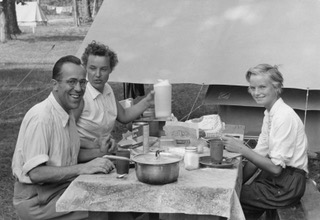
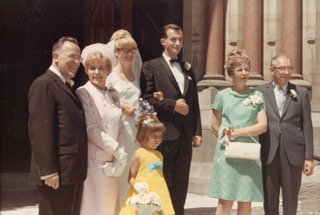
In London, they purchased a small home and then later a bigger one in a better neighbourhood. They had a son, Thomas, in 1956 and a daughter, Katherine, in 1962. Ann married and had three children (Geoffrey, Jennifer, and Christopher) and seven grandchildren. Katherine married (later divorced) and had two daughters (Marta and Michelle) and five grandchildren. Their son Tom remained a bachelor and spent his free time travelling or being in nature.
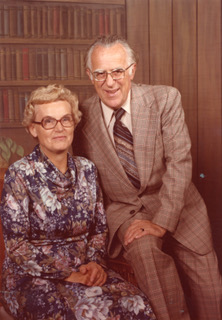
Guenther and Grete felt that Canada was good to them. They felt they were treated with respect and courtesy by Canadians and that Canadians are a generous people.