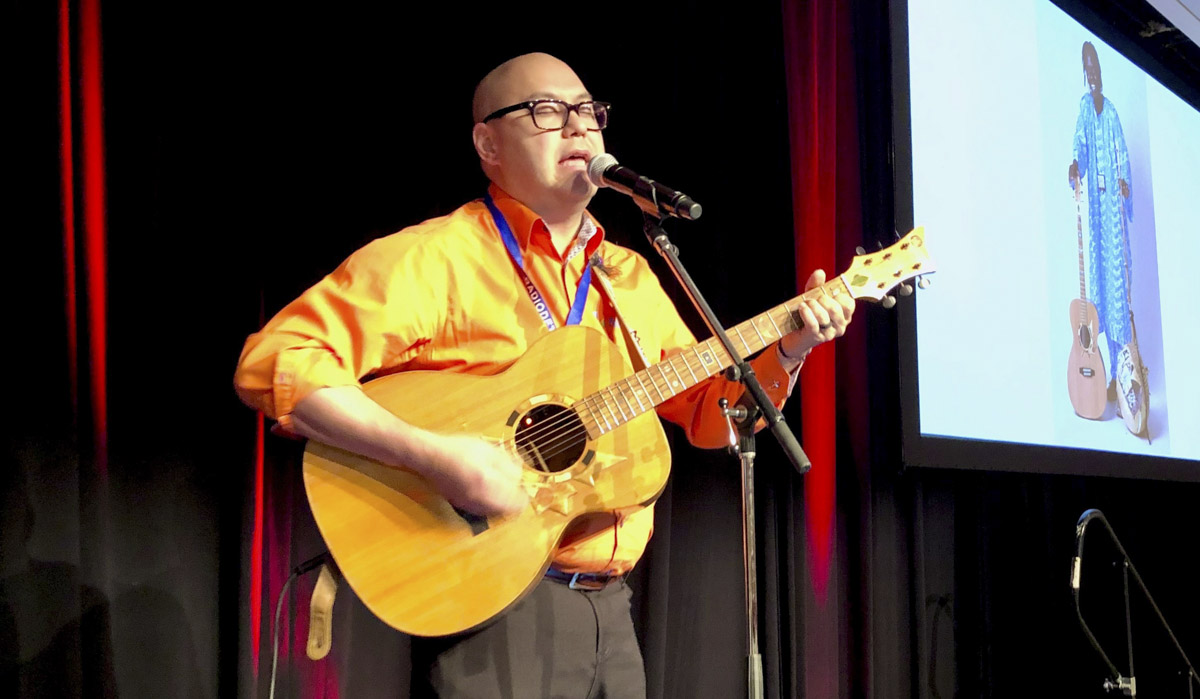
“I had no idea what was so important about this guitar I was asked to play today”, an emotional Jason Manning told public speaker Jowi Taylor.
“But now I know.”
Jason was a delegate at a conference about underground infrastructure being held at Casino Niagara. Jowi was the keynote speaker. Jason, the son of a Japanese Canadian mother and a father who immigrated from England, had been roped into performing a song at the end of the presentation without knowing what he was getting himself into.
“I’ve played in bars and pubs for 30 years, but mostly in the background,” Jason says, looking back at the performance. He notes that he normally doesn’t sing, especially in front of work colleagues. “I try not to have those two worlds collide.”
Canada in the shape of a guitar
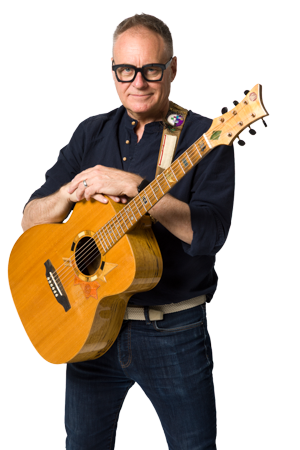
Jowi, the presenter, is a radio host, writer, and creator of Six String Nation. The project is centred on a handmade guitar nicknamed Voyageur. It’s made up of wood and other materials related to significant places and stories from across the country. “The guitar includes so many pieces from different cultures and communities and characters from every province and territory of Canada,” says Jowi.
Launched in 2006, the project symbolizes Jowi’s notion that “we are greater than the sum of our parts.”
“In Canada, we don’t tell our stories well enough or often enough, and we don’t know each other as well as we should,” he says. As he describes it, the project “celebrates not just simply by summing up a bunch of stereotypes… but really living a sort of concentrated, profound Canadian identity that runs super deep.”
The guitar and the stories it holds inevitably connect with the audience. “One of the things I say at every presentation,” Jowi says, “is I guarantee you will have a connection to this guitar.”
Immigration Stories Included
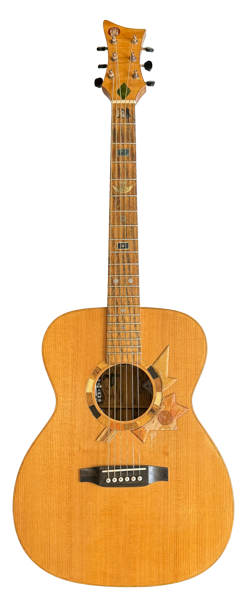
Canada’s immigration history is represented in the wood that makes up Voyageur. It includes material from a 125-year-old grain elevator in Saskatchewan built by Doukhobors (pacifists who escaped military conscription in Tsarist Russia); a doorway to Victoria’s Fan Tan Alley, the heart of Canada’s first Chinatown; part of the St. Michael's Orthodox Ukrainian Church in Gardenton, Manitoba, Canada's oldest existing Ukrainian church; and cedar from mill owner Jagat (“Jack”) Singh Uppal, who arrived in Canada in 1921 and was one of the first Sikhs in Vancouver’s public school system.
The guitar also incorporates part of a rafter from Pier 21, the national historic site where nearly a million immigrants arrived in Canada, now home to the Museum.
One of those immigrants was Jason Manning’s father, who arrived from England as a five-year-old boy. That was Jason’s first point of connection to the guitar.
The project includes a strap and a case, each adorned with meaningful materials.
Although Six String Nation is a celebration of Canada, not all of the stories associated with its materials are positive.
“I’ve tried not to shy away from the darker chapters,” says Jowi.
The Vancouver Asahi
One of those darker chapters connected personally with Jason Manning when he heard it. It centred around a bit of fabric from the jersey of the Vancouver Asahi baseball team, which had been incorporated into the guitar strap.
The Asahi were a highly successful amateur baseball team made up of Japanese Canadians. Founded in 1914, they played a style that was called “brain ball”, stealing bases and bunting with incredible accuracy to get on base and score runs and win championships.
After the bombing of Pearl Harbour in 1941, the Asahi would never play another game. Canada declared war on Japan, the government designated Japanese Canadians “enemy aliens,” and 22,000 people were put into internment camps.
Jowi’s presentations usually end with a performance by a preselected audience member. He says the performance is most emotional when that person plays something meaningful to them.
Jason, who’d unwittingly volunteered to play a song, stood in front of Jowi, Voyageur hung over his shoulder by the strap bearing a piece of the Asahi’s 1941 jersey.
Jason told Jowi that the presentation had hit him hard. His mother, he explained, had been born in Tashme, Canada’s largest Japanese Canadian internment camp during the Second World War.
Both his parents’ stories were represented in the guitar he held.
By sheer coincidence, the song he’d chosen to play was Bruce Cockburn’s Lovers in a Dangerous Time.
“It was unbelievable,” says Jowi. “The biggest gift this thing has ever given me is the connections that people make and that I get to witness.”
Voyageur’s Continuing Voyage
For twenty years, Jowi has travelled the country doing presentations for school and corporate groups and does shows with local songwriters who take turns playing Voyageur.
“I would very happily continue to traipse around the country carrying this thing, doing school presentations and community groups, for the rest of my life. It makes me really happy. I love doing it.”
Voyageur was constructed by master luthier George Rizsanyi and Sara (Sahara Jane) Nasr, who did the intricate inlay work on the fretboard and headstock, incorporating stone, metal, antler, and bone into the instrument. You can read more about the project at www.sixstringnation.com