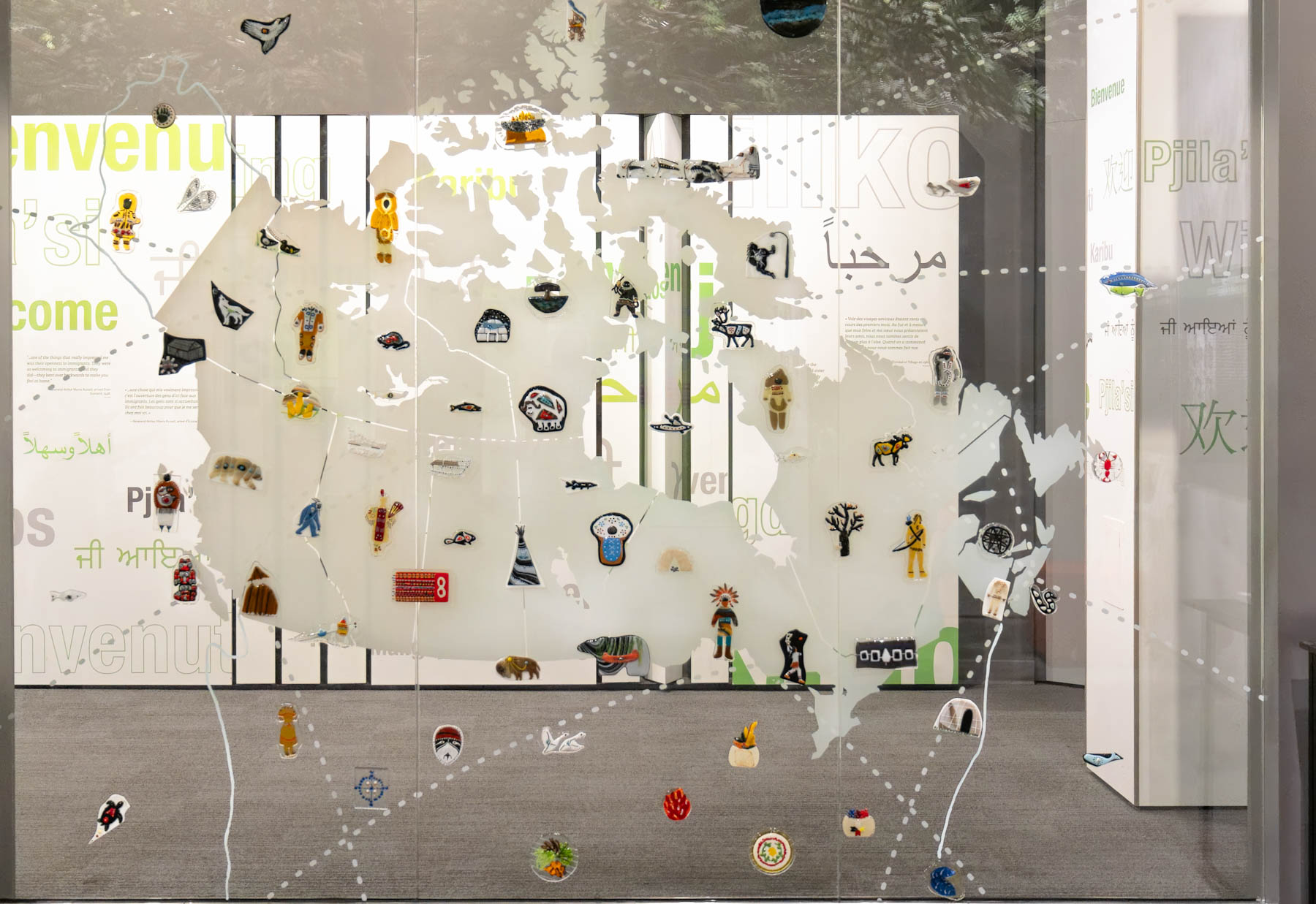
Melinda Robertson and Shannon Monk got excited when they saw the Museum’s glass map of Canada, with lines delineating national and provincial borders. They saw it as an opportunity to tell a story.
Indigenous people, Melinda explains, “travelled across Turtle Island. We didn't have the boundaries or the borders.”
The pair’s artistic installation, Welcome to Turtle Island, was installed in December. Turtle Island is a name for North America used by many Indigenous Peoples. The artwork is made up of 71 miniature artworks in glass, with depictions of plants, people, activities, and much more. The glass images are affixed to the map, symbolizing many aspects of Indigenous ways of life throughout and beyond the territory now known as Canada.
A lucky meeting
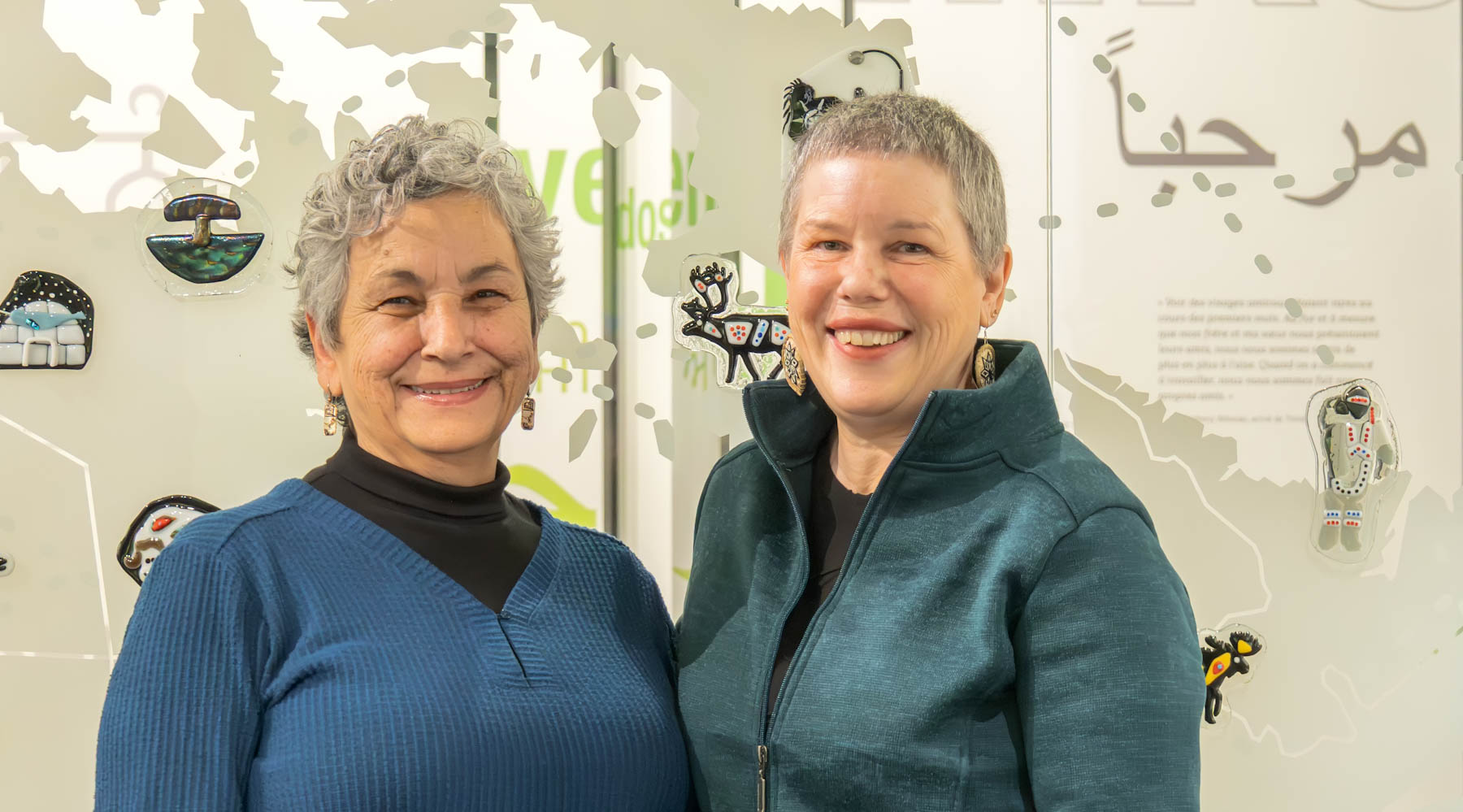
The two artists met because, as Melinda explains, “her daughter was married to my son… They broke up, but we didn't.”
“For the two of us to be so connected and then to also be glass artists was pretty crazy,” says Shannon, “it was meant to be.”
And yet the two bring different strengths to their work.
“I would consider myself an academic,” says Shannon. Regarding Melinda, “she's a top-notch glass artist… she's really helped me to refine my skills.”
Indigenous representation
The task of representing Indigenous life throughout such a vast territory is daunting. The pair brainstormed over 200 ideas. Because it was practically impossible to represent all of the Nations in the territory, they decided to focus on tribal linguistic families. “We felt that was a really fair way to do it,” Shannon explains, “because everyone has an affiliation with one or another linguistic group.”
Indigenous representation in a museum of immigration is important. The presence of and impact on Indigenous Peoples is a fundamental but often forgotten part of the history of both early colonial settlement and later immigration. “There wasn't as much of a story of the First Nations reaction and perspective on immigration previously in museums,” Shannon says, “and we thought this would be a nice way to tell that story, especially in this era of reconciliation.”
“It's only in the last 10 or 15 years that we've kind of seen any modern representation of Indigenous Peoples.” Instead, she explains, they have been portrayed in a historical context. “Indigenous Peoples in Canada are flourishing, vibrant societies that still exist.”
An ongoing story
For the pair, the story of immigration, just like the story of Indigenous Peoples, is in continual evolution. “Our people have always travelled and traded throughout Turtle Island, and beyond. We wanted to reinforce the idea that cultures evolve and grow and adapt,” Shannon says, “and that immigration is part of that story as people continue to weave their identities together and form new identities, as in the case of the Métis, for example.”
Visitors can see Welcome to Turtle Island in the Canadian Immigration Story exhibition. A book accompanying the exhibit explains each of the 71 pieces. The installation will be in the Museum until the end of 2027.