By Steven Schwinghamer, Historian
For over a century, Canadian immigration authorities have used language proficiency as a point of consideration in deciding whether a migrant is admissible to Canada.[1] This is not generally a controversial aspect of current Canadian immigration policy, but when the practice first emerged as an immigration control measure in the early 1900s, it was hotly debated. The use of literacy tests to determine a person’s fitness for civic inclusion arose in the context of the ideas of hierarchies of race and civilization that animated scientific, public, and political thought among white, “Western” countries and colonies. Depending on the structure of the test, undesirable immigrants could be failed, while desirable immigrants were passed by changing the text or language used.
The literacy test engendered significant debate as a measure of racist exclusion, alongside the head tax and outright bans.[2] However, public sentiment and debate did not match the actions taken by government officials in implementing Canada’s first structured literacy test. The action test of 1920 shows that Canada’s early literacy policy in immigration developed alongside, but was distinct from, the domestic and global contexts of racist restriction.
Domestic and Global Contexts
Within Canada, the debate over exclusion and undesirability threw the issue of jurisdiction, a fundamental aspect of Canadian confederation, into sharp relief. Despite common perception, immigration in Canada is not a matter of federal jurisdiction. Instead, following section 95 of the Constitution Act, 1867, the responsibility for immigration to Canada is shared between the provinces and the federal government.[3] Insofar as provincial legislation on agriculture or immigration “is not repugnant to any Act of the Parliament of Canada,” provincial and federal regulation of immigration can co-exist in Canada—although as a matter of capacity, historically much of the practice of immigration regulation has fallen to the federal government. The boundaries of that joint authority were and remain a matter of friction between all levels of government. In the early-twentieth century, as public and political opinion turned against the admission of immigrants from Asia, this played out as a contest not over admissions but over exclusions.
Well before the passage of any literacy requirement by the federal government, the use of language testing to restrict Asian immigration was hotly debated in the provincial legislature in British Columbia, and in terms that made clear the perception of a sharp division between Ottawa and Victoria on matters of immigration. In 1900, one member of the opposition in British Columbia, repeatedly questioning the governance of Asian migrants, said “The Minister of Mines was a Native Son and ought to know better than these Eastern men the gravity of the case…The question would be agitated until the matter was dealt with as the people desired.”[4] That year, the BC government did pass a literacy requirement for immigrants, and it was promptly disallowed by the federal government amid diplomatic protest from the Japanese government.[5] In response, some BC politicians openly stated they would simply propose and pass the restrictive legislation again and again until a literacy test was in place.[6] This did in fact become a bit of a routine, such that historian Patricia Roy calls the re-enactment and disallowance of provincial immigration laws in BC “a pro forma exercise” during the years between 1900 and 1907.[7] The province was such a battleground for control of immigration because it was the site of arrival and settlement for many early Asian immigrants to Canada, and public response reflected and produced contemporary racism, eugenics, and white supremacy.
At that time, similar racist politics emerged in white settler colonial states around the world. This followed the emergence of the slippery and shifting idea of “Caucasian” race and “whiteness” through the nineteenth century—categories that were and are drawn inconsistently by those who use them.[8] 1907 was something of a watershed year in anti-Asian racism along the Pacific coast of North America, with anti-Asian riots from San Francisco to Vancouver both expressing and producing an ugly public mood.[9] This parallel development is noted by legal scholar Daniel Ghezelbash, writing “[i]n the late nineteenth and early twentieth century, governments in the United States and the self-governing anglophone dominions of Canada, Australia, New Zealand and South Africa introduced very similar mechanisms aimed at limiting the immigration of Chinese and later all ‘non-white’ persons.”[10] Ghezelbash further addresses the natality of these tests, noting that “the origins of literacy testing as a tool of exclusion can be traced to measures aimed at disenfranchising black voters in the southern American states.”[11] Although efforts to entrench those voter exclusions into American immigration law failed in the short term—a Presidential veto cut the immigration bill short in 1896—the useful racist tool was noted and copied halfway around the world, in the British Colony of Natal.
This gives rise to the odd name for the tests—Natal tests—as the British colony (later part of South Africa) pioneered the measure to restrict the entry of South Asian immigrants. Targeting these immigrants, especially Indians, based on their place of origin was contrary to the broader interests of the British Empire at the time.[12] The nineteenth century was a time of significant resistance to and refusal of British rule over India. Freedom of movement within the empire was a promised benefit of being a British subject, and the imperial government understood that if people could not travel and enjoy the protections of British law throughout the empire, this would provide further fuel to the movement for political independence in India. The solution to the need to camouflage this race-based exclusion was to test for literacy, especially in English, and in a way that left considerable leeway to the examiner to both set and score the test. The contemporary Secretary of State for the Colonies, Joseph Chamberlain, endorsed this approach. He was quoted in British Columbia by the Victoria Daily Times in 1899, which printed his argument of the importance “if there is any real prospect of a large influx of Japanese laborers into Canada, of dealing with it by legislation of the Dominion parliament on the lines of the accompanying Natal act.”[13]
Despite the momentum this kind of exclusion gained, a literacy test did not figure in Canadian policies in the early twentieth century. The Immigration Act, 1906 is in many ways Canada’s first recognizable immigration legislation, in part because in incorporates a dedicated discussion of prohibited classes. It seems to presume migrant literacy, but only in relation to requiring that ships post the Canadian regulations protecting immigrants in transit in “English, French, Swedish, Danish, German, Russian, and Yiddish languages, and such other languages as are ordered from time to time by the superintendent of immigration.”[14] There is no stated language requirement in 1906, though, nor in 1910. This is odd, in that by 1904 the passenger manifests filed by ships for use as immigration returns in Canada included a direct question regarding the literacy of immigrants.[15] Although this information was being gathered on the manifest, there was no confirmation of literacy during the civil examination, and illiteracy was not a barrier to entry.[16]
In 1913, the long-serving and influential Superintendent of Immigration W.D. Scott replied to a clergyman asking that a literacy test be implemented that “the view taken of this question in the past has been that many of these people, who would make good settlers, have had no opportunity of learning English, and it has not been considered that this inability is of sufficient weight to prevent the entry of persons who may be otherwise desirable.”[17] The distinction marks something of a fork in the road between Canadian immigration policy and that of other countries and colonies enacting restrictions. The reasoning behind it may be the emphasis in policy at the time on settling farmers and farmer labourers in the Canadian West—and indeed, when Canada did finally enact a literacy test, the very first exemptions allowed were for immigrants and seasonal workers coming from preferred countries to work in agriculture.[18] Although others still had to take the test, it was most likely available in their own languages: illiteracy was the privilege of otherwise “desirable” immigrants.
Scott did stress that it was significant that people resident in the country, especially the children of immigrants, learn English or French, and this position was aligned with the Naturalization Act, 1914, which required of an applicant for naturalization that “he is of good character and has an adequate knowledge of either the English or French languages.”[19] This reflects an acceptance of the relegation or marginalization of newcomers in contrast to the expectation of a practiced, substantive citizenship for those who are granted status.[20]
Producing Illiteracy Exclusions in North America
Scott’s relaxed attitude regarding the language skills of immigrants was not responsive to a growing public nativist backlash to large-scale arrival in Canada. The pressures of racist exclusion and the perception of labour competition had been building through the early years of the twentieth century. This exclusionary and racist politics fed on similar attitudes in the United States. Historian Patricia Roy, in pointing out the transnational nature of the Asiatic Exclusion League (AEL, founded in San Francisco in 1905), also highlighted the role of the Vancouver Trades and Labour Council in opening chapters of the AEL north of the border, and in creating a committee to work with exclusionary activists in Seattle.[21] These transnational pressures contributed to the US federal government finally adopting a literacy test in 1917—a measure that had been described by the press in Canada as a means to “bar Asiatics from the United States.”[22] Historian A. Thomas Lane highlighted the American Federation of Labor’s staunch support for immigration restrictions at the turn of the century, including backing the literacy test between 1906 and 1917.[23] The American Dillingham Report on Immigration cemented this political pressure into policy advice at the end of 1910, noting in its recommendations that “[a] majority of the Commission favor the reading and writing test as the most feasible single method of restricting undesirable immigration.”[24] Canada’s parliament followed this lead from the US and passed a series of amendments to immigration law in 1919, including the introduction and description of the first systematic literacy test for immigrants. The amendment read:
Persons over fifteen years of age, physically capable of reading, who cannot read the English or the French language or some other language or dialect…For the purpose of ascertaining whether aliens can read, the immigration officer shall use slips of uniform size prepared by direction of the Minister, each containing not less than thirty and not more than forty words in ordinary use printed in plainly legible type in the language or dialect the person may designate as the one in which he desires the examination to be made, and he shall be required to read the words printed on the slip in such language or dialect.[25]
This was a close parallel to the American regulation—one of many examples in US and Canadian immigration policy of what historian Kornel Chang has termed “transnational white solidarity” around racist and nativist national exclusions, projects of law in both the US and Canada that entailed not just the land boundary but “enforcing an imaginary line between the Asia-Pacific world and the North American West.”[26] The changes to immigration policy introduced in 1919 were notoriously and intentionally restrictive. The 1919 amendments expanded existing prohibitions, barring immigrants on the grounds of ideology, alcoholism, and a disguised barrier to members of the peace churches based on “peculiar customs, habits, modes of life and methods of holding property.”[27]
Besides race, ideology, and nationalism, immigration restrictions at this time were also deeply intertwined with popular pseudoscience, including eugenics. The Canadian context for the literacy test and other restrictions demonstrates this: it is mentioned alongside “climatic conditions”—the coded policy exclusion to bar out Black immigrants on the supposed medical basis of their bodies being unsuited to Canadian weather. Major Hume Cronyn, the Unionist Member of Parliament for London, while arguing for these measures to control entry, asked a group of women’s organizations “are we prepared that our descendants should intermarry with these people?”[28]
Just as these changes were introduced, the immigration branch also made a change in how immigrants were processed on arrival into the country, going from the well-established long-form manifests to one form per passenger. This new form was unevenly introduced and only lasted about five years, but it did include a literacy question—"can you read?”—like earlier forms, as well asking in what language the person could read.[29] Although short-lived and little-loved by the transportation agents obliged to submit the paperwork, the Form 30A provided a useful and tangible bureaucratic boundary on the incorporation of literacy into admissibility in Canada.
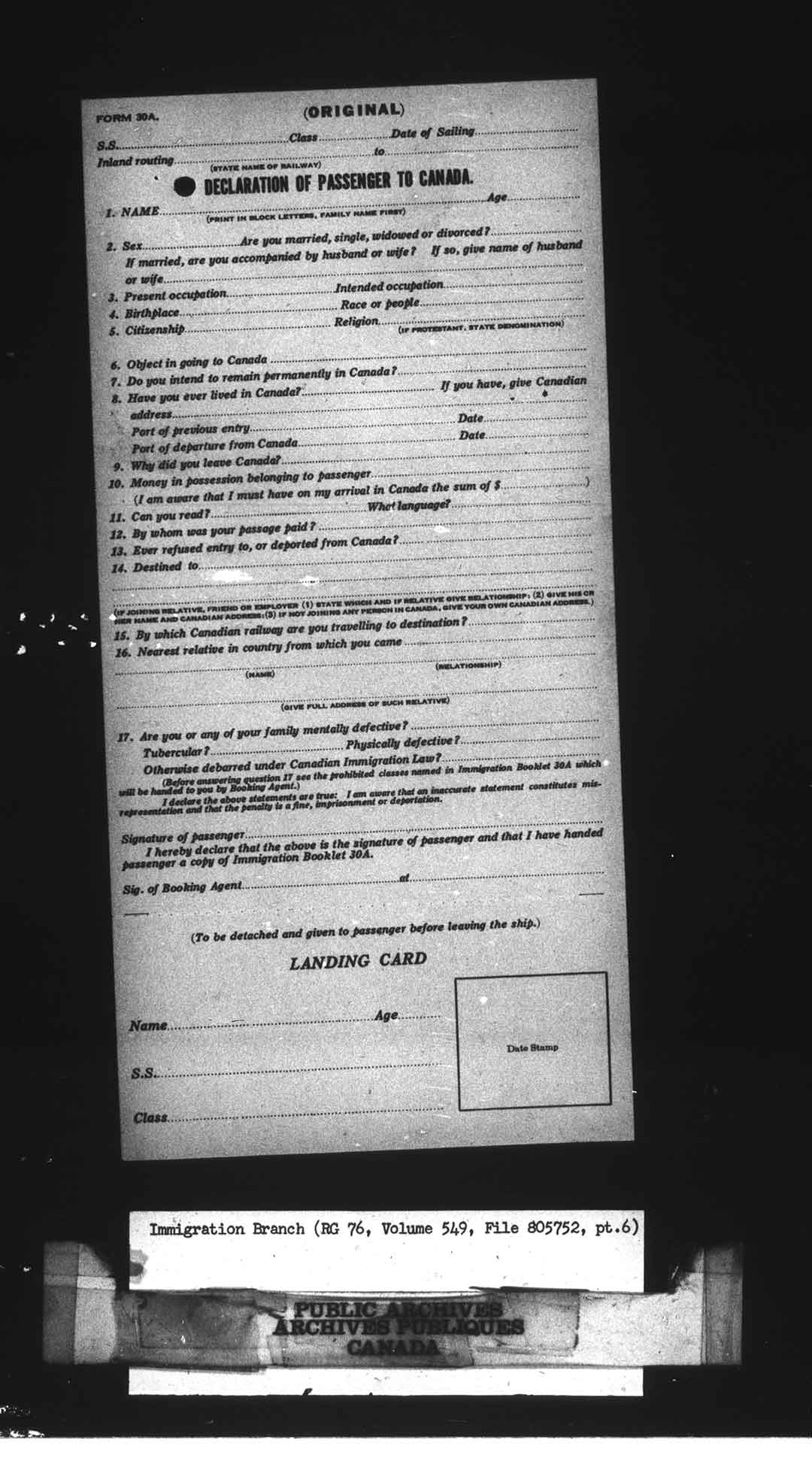
Library and Archives Canada/Department of Employment and Immigration fonds/RG76 Vol 549 File 805752 Part 6.
Implementing Testing
The introduction of this new literacy requirement created a certain amount of confusion among Canadian immigration officials: the language of the immigration act specified a test, but what slips could be used? With what words? How many languages would be available and acceptable? In the United States, the parallel policy development had arrived at having immigrants read short passages from the Bible, not with “religious motives, but…solely to use a book that is universally translated and familiar to every tongue.”[30] This was also done in Canada, using a publication called “The Gospel in Many Tongues.”[31] The Canadian immigration branch also requested and was gifted a number of sets of American literacy test cards to inform development of their own resources.[32]
These reading tests were almost immediately made even more problematic by a circular that directed uneven application of literacy requirements. The Acting Deputy Minister of Immigration, W.W. Cory, instructed immigration officers that “consideration be shown” to illiterate but otherwise admissible immigrants from Great Britain, Ireland, the US, France, Belgium, Norway, Denmark, Sweden, Holland, Italy, and Switzerland, if they intended to be farmers, agricultural labourers, or domestics in Canada. Seasonal labourers for certain key areas were also indicated for “consideration.”[33] This discriminatory exemption restored the inequitable hierarchy of preference—European immigrants bound for certain occupations—found elsewhere in immigration policy and diluted the integrity of the initial literacy test.
Application of the policy was further hampered by the fact that the tests as indicated in the amendments and as initially proposed were not workable. This had been raised in Parliament as the amendments were debated, but a straight party-line vote quashed efforts to remove the literacy test.[34] As observed by Frederick C. Blair, then Secretary of the Department of Immigration and Colonization, “If an immigrant applies at one of our ports of entry and claims to be a Russian, if he were shrewd, he might give us a line of Russian talk for which we would be none the wiser, but the talk might have no connection at all with the literacy test.”[35] Simple reading tests could not be administered by officers who did not know the relevant language. From this arose the idea of an action test: a test of reading a phrase that indicates a simple physical action. If the migrant read the instructions correctly, they would perform the action as described, and the examining officer needed only to observe the action, not understand speech in any other language.
The immigration branch arrived at ten short phrases to form the action test. The immigration officer would present an immigrant a single card, bearing an “action” in the immigrant’s preferred language on one side and a translation in English on the other. The actions were:
- Stretch forth your right hand and then your left hand after which raise both your hands above your head.
- Take off your hat and put your hand on top of your head.
- Stand on your left foot and then on your right foot.
- Walk across the room and close the door.
- Show me your railway ticket and your money.
- Take up the book on my table and open it at page eighty-four.
- Take three steps forward, then three steps backward.
- Remove your hat and be seated while I attend to some other matters.
- Remove your hat and lay it on my table.
- Take the pencil lying on my table and sit down on the chair and write your name.
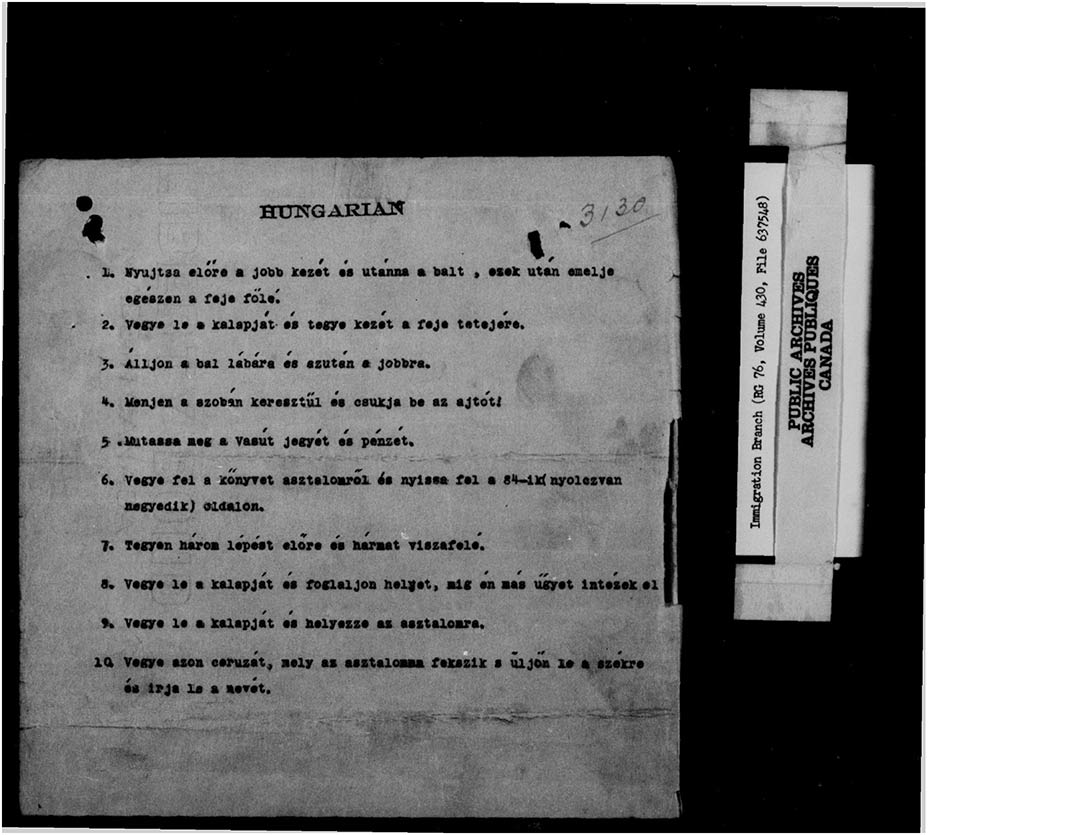
Library and Archives Canada/Department of Employment and Immigration fonds/RG76 Vol 430 File 637548.
The test as proposed is interesting for a few reasons that, taken together, separate it from the exclusionary policies outlined above. First, unlike the most stringent Natal formula tests, it accommodated literacy in the immigrant’s own language, so it reduced the possibility of exclusions based on an immigrant’s educational, cultural, or colonial / imperial ties. Second, there was less latitude for an inspecting officer to manipulate the test or its result, although any individual and subjective test like this would still be vulnerable to the discretion of front-line officials. Finally—and notably—the test cards were translated into the languages of groups that were targeted for exclusion, which suggests that it was not implemented as a barrier in concert with other policies.
The initial batch of cards came in twenty-one languages, listed at the time as Arabic, Bohemian, Chinese, Croatian, Danish, Finnish, French, Gurmakhi, Hungarian, Icelandic, Italian, Japanese, Maltese, Norwegian, Polish, Roumanian, Russian, Serbian, Swedish, Urdu, and Yiddish.[36] These were distributed across the country, and to shipping lines as the transportation agents and carriers often carried out their own screening to ensure passengers were compliant with immigration regulations before allowing them to board. (If they brought an inadmissible passenger to Canada, the shipping companies were liable for the costs of deporting the person from Canada.)
Although it did not conform to the language of the amended immigration act, this physical literacy test was widely distributed and used by Canadian immigration agents through the 1920s. The action test of 1920 shows that Canada’s early literacy policy in immigration developed alongside, but was distinct from, the domestic and global contexts of racist ideology and policy restrictions. With its function as an actual test of ability rather than as a disguised tool for exclusion, it sits apart from many of the other Natal tests adopted in white settler colonial states.
Epilogue: Literacy in Later Policy
Literacy testing remained in part of the immigration act proper until 1952, when a new immigration act was passed. The Immigration Act, 1952 pushed literacy testing out of the language of the Act itself and into regulations, noting the power of Cabinet to make regulations respecting “literacy, medical and other examinations or tests and the prohibiting or limiting of admission of persons who are unable to pass them.”[37] The regulation that was put in place in 1955, however, was rather open-ended:
The Minister may issue instructions that no person over sixteen years of age shall be admitted to Canada unless such person is able to read in his own language and this ability has been established from the reading of cards printed in capital letters, written in such Persons own language or in the language or he wishes the test to be made and approved by the Minister, and such instructions shall not apply to the ascendant or the wife of a person who has been landed in Canada or whose coming to Canada is authorized by the Minister.[38]
In 1967, the introduction of the points system included “knowledge of the English and French languages.” This was expanded in the rubric for the points system proper according to an applicant’s ability to read, write, and speak each of the official languages, and was initially valued at ten points out of a possible one hundred (fifty generally being needed to be considered admissible).[39] This emphasis on Canada’s official languages separates the newer requirements for literacy from the action test and its evaluation of immigrant educational attainment in their own milieu.
The author thanks Emily Burton, Laura Madokoro, and Jan Raska for their reflections on drafts of this blog.
- Refugees and Citizenship Canada Immigration, ‘Express Entry: Language Test Results’, 13 December 2024, https://www.canada.ca/en/immigration-refugees-citizenship/services/immigrate-canada/express-entry/documents/language-test.html.↩
- Patricia E. Roy, A White Man’s Province: British Columbia Politicians and Chinese and Japanese Immigrants, 1858 - 1914, Reprinted (Vancouver: Univ. of British Columbia Press, 1990), 100–103.↩
- The Constitution Act, 1867, § 95 (2024), https://laws-lois.justice.gc.ca/eng/const/.↩
- ‘Provincial Parliament: Exclusion of Mongolians Again Occupies the Attention of Legislators’, Victoria Daily Times (Victoria, BC), 8 August 1900..↩
- Roy, A White Man’s Province, 105–6.↩
- ‘The Provincial Progressive Party - Harmonious Meetings Held at Kamloops’, Victoria Daily Times (Victoria, BC), 22 April 1902.↩
- Roy, A White Man’s Province, 154.↩
- Matthew Frye Jacobson, Whiteness of a Different Color: European Immigrants and the Alchemy of Race (Cambridge (Mass.): Harvard university press, 1998), 210–22.↩
- Erika Lee, ‘Hemispheric Orientalism and the 1907 Pacific Coast Race Riots’, Amerasia Journal 33, no. 2 (2007): 19, https://doi.org/10.17953/amer.33.2.y263745731125524.↩
- Daniel Ghezelbash, ‘Legal Transfers of Restrictive Immigration Laws: A Historical Perspective’, International and Comparative Law Quarterly 66, no. 1 (2017): 239, https://doi.org/10.1017/S0020589316000373.↩
- Ghezelbash, ‘Legal Transfers of Restrictive Immigration Laws’, 245.↩
- Adam McKeown, Melancholy Order: Asian Migration and the Globalization of Borders, Columbia Studies in International and Global History (New York: Columbia University Press, 2008), 192–93.↩
- ‘The Mikado’s Protest’, Victoria Daily Times (Victoria, BC), 19 January 1899.↩
- An Act Respecting Immigration and Immigrants, § 44 (1906).↩
- Library and Archives Canada, RG 76, Department of Employment and Immigration Fonds, ‘Passenger Lists, 1865–1935’, n.d., T-479 to T-520, T-4689 to T-4874, T-14700 to T-14938, C-4511 to C-4542.↩
- W.D Scott, Superintendent of Immigration to Dr. Roche, Minister of Immigration, 14 February 1916, Library and Archives Canada, RG 76, Immigration Branch, Volume 430, File 637548, ‘Illiteracy - General File’.↩
- W.D Scott, Superintendent of Immigration to Rev. W. Bowman Tucker, Superintendent of the City Mission, Montreal, 15 September 1913, Library and Archives Canada, RG 76, Immigration Branch, Volume 430, File 637548, ‘Illiteracy - General File’.↩
- W.W. Cory, ‘Circular to Immigration Officers’, 2 July 1919, Library and Archives Canada, RG 76, Immigration Branch, Volume 430, File 637548, ‘Illiteracy - General File’.↩
- An Act Respecting British Nationality, Naturalization and Aliens, § 2 (1915).↩
- Jatinder Mann, Citizenship in Transnational Perspective: Australia, Canada, and Aotearoa New Zealand, 2nd ed, Politics of Citizenship and Migration Series (Cham: Springer International Publishing AG, 2023), 98–99.↩
- Patricia E. Roy, A White Man’s Province: British Columbia Politicians and Chinese and Japanese Immigrants, 1858 - 1914, Reprinted (Vancouver: Univ. of British Columbia Press, 1990), 190.↩
- ‘Drastic Bill Is Up in Senate’, Vancouver Province (Vancouver BC), 5 February 1913, Library and Archives Canada, RG 76, Immigration Branch, Volume 430, File 637548, ‘Illiteracy - General File’.↩
- A. T. Lane, ‘American Trade Unions, Mass Immigration and the Literacy Test: 1900–1917’, Labor History 25, no. 1 (1984): 5, https://doi.org/10.1080/00236568408584739.↩
- United States. Immigration Commission (1907-1910) and William P. (William Paul) Dillingham, Reports of the Immigration Commission, with Prelinger Library (Govt. Print. Off., 1911), 48, http://archive.org/details/reportsofimmigra01unitrich.↩
- An Act to Amend The Immigration Act, § 3(t) (1919).↩
- Kornel Chang, ‘Enforcing Transnational White Solidarity: Asian Migration and the Formation of the U.S.-Canadian Boundary’, American Quarterly 60, no. 3 (2008): 693–94, https://doi.org/10.1353/aq.0.0027.↩
- An Act to Amend The Immigration Act.↩
- ‘Would Plan Intelligent Nation’, Ottawa Citizen (Ottawa ON), 8 May 1919.↩
- Library and Archives Canada, RG 76. Department of Employment and Immigration Fonds, ‘Form 30A, 1919-1924 (Ocean Arrivals)’, n.d., T-14939 to T-15248.↩
- ‘Bible in Literacy Test’, The Washington Post (Washington DC), 28 March 1917.↩
- W.R. Little, Commissioner of Immigration to W.L. Barnstead, Dominion Immigration Agent, Halifax, 7 August 1919, Library and Archives Canada, RG 76, Immigration Branch, Volume 430, File 637548, ‘Illiteracy - General File’.↩
- John H. Clark, US Commissioner of Immigration, Montreal to F. C. Blair, Secretary, Department of Immigration and Colonization, 22 August 1919, Library and Archives Canada, RG 76, Immigration Branch, Volume 430, File 637548, ‘Illiteracy - General File’.↩
- W.W. Cory, ‘Circular to Immigration Officers’.↩
- ‘Literacy Test Is Adopted in the Immigration Bill’, Ottawa Citizen (Ottawa ON), 2 May 1919.↩
- F. C. Blair, Secretary, Department of Immigration and Colonization to Fred Cook, Assistant King’s Printer, 18 June 1920, Library and Archives Canada, RG 76, Immigration Branch, Volume 430, File 637548, ‘Illiteracy - General File’.↩
- W.R. Little, Commissioner of Immigration to J.G. Young, Dominion Immigration Agent, Sydney NS, 2 April 1921, Library and Archives Canada, RG 76, Immigration Branch, Volume 430, File 637548, ‘Illiteracy - General File’.↩
- An Act Respecting Immigration, § 61(b) (1952).↩
- Department of Citizenship and Immigration, Instructions for the Guidance of Immigration and Visa Officers (Ottawa: DCI, 1953), 2:13, Library and Archives Canada, RG 76 Vol 932 Binder 2.↩
- Canada, ‘P.C. 1967-1616’, 16 August 1967.↩